The buyer's flagship event is two weeks out, the venue team sends back the stage screen specs, and the opener film master that has been in review for a month is the wrong shape. The frame the audience will see is taller, or wider, or wraps around the speaker. The composition that read well on a laptop falls apart on the actual canvas.
Event opener films should be authored for the canvas the audience will see, not adapted to it after the fact. For non-standard stage screens, that decision shapes the storyboard, the 3D environment build, the motion design, and the delivery codec. Dustin Hill Productions plans the canvas into the brief on day one so what arrives in the venue lands clean.
The first thing the AV team asks for is dimensions
When the venue specs come back, the opener film's master should already match. The pixel width, the pixel height, the aspect ratio, and the playback codec sit at the top of the production brief, not at the bottom of the technical handover.
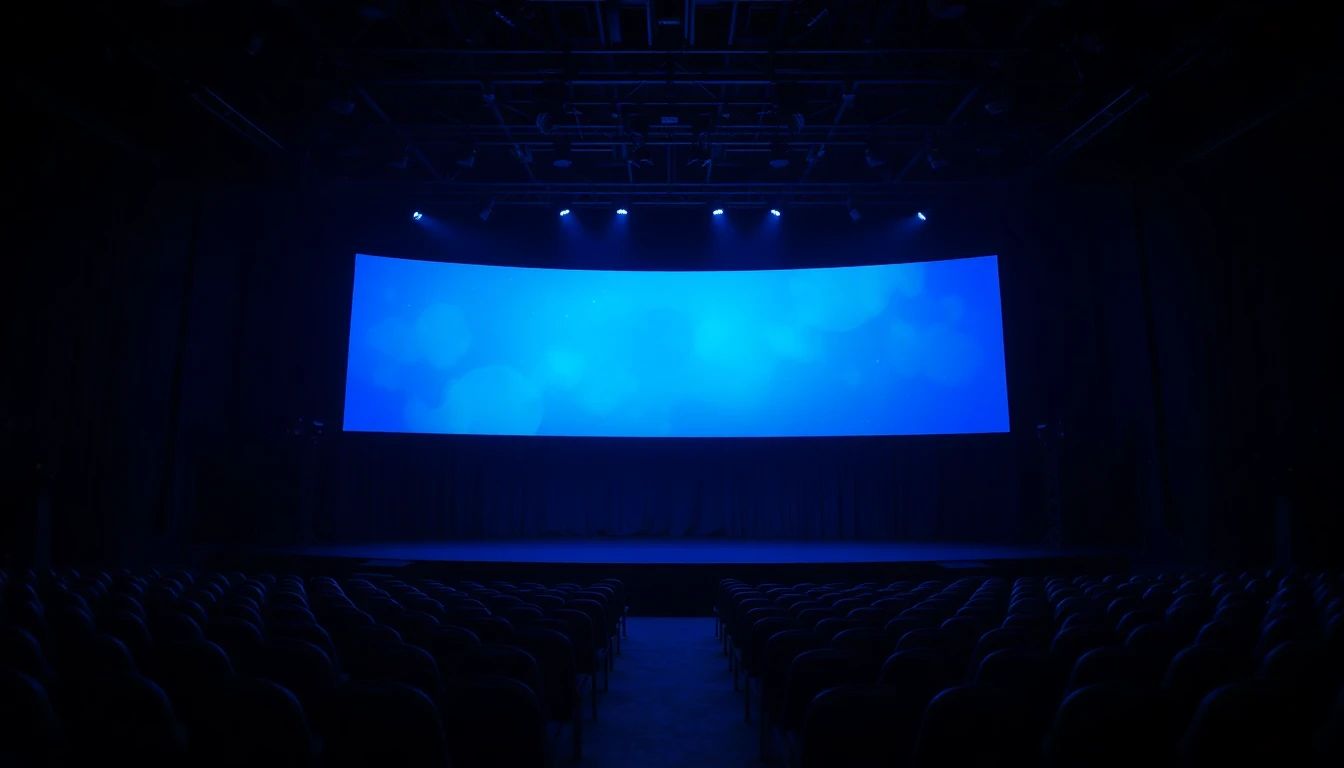
For a regional banking group running an investor day at a custom-built LED arena, the screen might be 7680 by 1440 pixels split across a 5:1 ribbon. The opener that fits that screen is composed and animated for 5:1 from the storyboard panel, not from a 1920 by 1080 master cropped down. For a pharmaceutical company commissioning an anniversary celebration at a venue with a curved 270-degree LED backdrop, the master file is a triple-panel composite delivered as one ultra-wide canvas, with the storyboard already drawing the audience's eye through the curve.
The dimensions question is usually the first technical question on the call sheet. The brief that answers it before the storyboard begins is the brief that ships on time.
Common non-standard canvases at flagship events
The category covers more than ultra-wide LED walls. A typical Dustin Hill brief might ask for a 5:1 to 9:1 ribbon on a conference stage, a curved 180 to 270 degree LED backdrop at a corporate gala, or vertical column screens flanking a presenter podium at an investor day. Multi-panel video walls are common too, where each panel reads on its own but the composition has to land across all of them at once. Projection-mapped stage backdrops, where the projection surface is irregular such as a building facade or a sculpted set piece, fall into the same authoring problem.
Each canvas calls for different framing decisions. Motion design has to be planned for the shape of the screen, and the safe-zone discipline has to account for the worst viewing seat in the room.
A vertical column composition built for a banking investor day cannot be lifted from a 16:9 master. The visual hierarchy reorganizes around the vertical axis. The brand mark sits differently. The motion paths read differently. The work is not a crop. It is a different film.
What changes when you author for the canvas, not 16:9
Authoring for the target canvas changes five things from the storyboard panel forward.
Composition is the first. The primary subject sits where the venue's sightlines actually focus, which for a wide ribbon is rarely centered. For a curved backdrop, the subject sits in the visual sweet spot of the dominant viewing arc, usually slightly off-axis from the geometric center of the screen.
Focal subject placement is the second. A vertical column screen pulls the eye up and down, not left and right. The story has to unfold along that axis. A logistics company's regional summit film built for vertical columns flanking the keynote speaker reads top-down, with the brand mark anchored low and the supporting visuals rising into negative space above it.
Motion paths are the third. A 9:1 ribbon supports lateral motion as a primary design language. A 16:9 master forced onto a 9:1 cannot achieve that motion without retroactive recomposition. The motion is built into the storyboard from day one or it does not exist in the final film.
Text safe zones are the fourth. Any text in the film, including the brand mark, sits inside the safe zone of the worst viewing seat in the venue. For a curved LED backdrop where the front row is closer than the back rows, that calculation depends on which seat the buyer most wants the message to land on.
Lighting direction is the fifth. 3D-built environments on non-standard canvases benefit from lighting that respects the venue's own ambient light. The director of photography on the 3D side matches the venue's house light temperature into the renders so the opener feels like part of the room, not an alien object placed in front of the audience.
3D-built worlds carry custom canvases better than live action
Live-action production for non-standard canvases is possible but creates compounding logistical problems. The shot has to be captured at a higher resolution than the master, then masked or extended for the target aspect ratio. The actors and props need to be placed with the canvas in mind, which constrains the shoot. The director has less freedom because the framing is already committed.
3D-built worlds remove that constraint. The camera path inside the 3D scene is set to the target aspect ratio from the storyboard stage. The environment is modeled around what the camera will see, not around what a physical set would need. For a medical device company commissioning a 5:1 ribbon film celebrating a Singapore expansion milestone, the entire visual environment can be a single coherent space that the camera moves through laterally, with the brand's signature product appearing at the visual climax exactly where the audience's eye is already focused.
This is one reason the most ambitious event opener films now lean 3D. The technical freedom matches the canvas freedom. The film becomes the room, instead of fighting it.
The internal sign-off process changes too
Most marketing reviewers expect 16:9 mocks. The deck templates assume horizontal video. So do the email previews and the dailies viewer. When the opener film is being authored for a 9:1 ribbon, the review experience needs to be set up to match.
Dustin Hill builds the internal review files in two formats. The first is the canvas-accurate master, shown at the target aspect ratio in a viewer that respects it. The second is a 16:9 preview cut with the canvas-accurate content letterboxed inside, so reviewers who are stuck on a laptop screen can still see the composition as intended. Both go into the review cycle together. Sign-off happens on the canvas-accurate master. The preview is for awareness only.
Setting that expectation in the brief reduces the most common late-stage problem. A reviewer who has been looking at a 16:9 mock for a month sees the canvas-accurate cut for the first time at venue install and asks why the composition has changed. It has not changed. The reviewer has been seeing the wrong shape the whole time.
Delivery to the AV team and venue playback
Once the master is approved, the delivery file goes to the AV team in whatever specification their playback system requires. Master codec, frame rate, color space, audio format, and frame count are all venue-specific and sometimes vendor-specific. A film authored for an LED arena running a Disguise media server has different delivery requirements from one running on a green-room render farm feeding a custom playback grid.
Dustin Hill confirms the playback specification before the master export. The version that lands on the AV team's media server is the version the audience will see, with no recompression and no in-venue re-encode. That single delivery step is where many event opener projects lose quality, and it is the easiest one to get right with a phone call to the AV vendor a week ahead of install.
The canvas is part of the brief. Treating it as a post-production adjustment is the most common reason event opener films land in the venue looking smaller than they should. The opposite move, designing the film from day one for the screen the audience will see, costs nothing extra at the brief stage and removes most of the late-stage friction.
For corporate video production at Dustin Hill, the canvas conversation happens on the first call. The venue specs come into the storyboard before any 3D modeling, motion design, or color work begins. By the time the film is delivered, it fits the screen the audience will see, the AV team can play it back without modification, and the room reads the way the buyer imagined it would.
An opener is one piece of the night. Where the rest of the evening also needs covering, that is event video production, and the two briefs are worth scoping together so one team owns both the screen and the room.