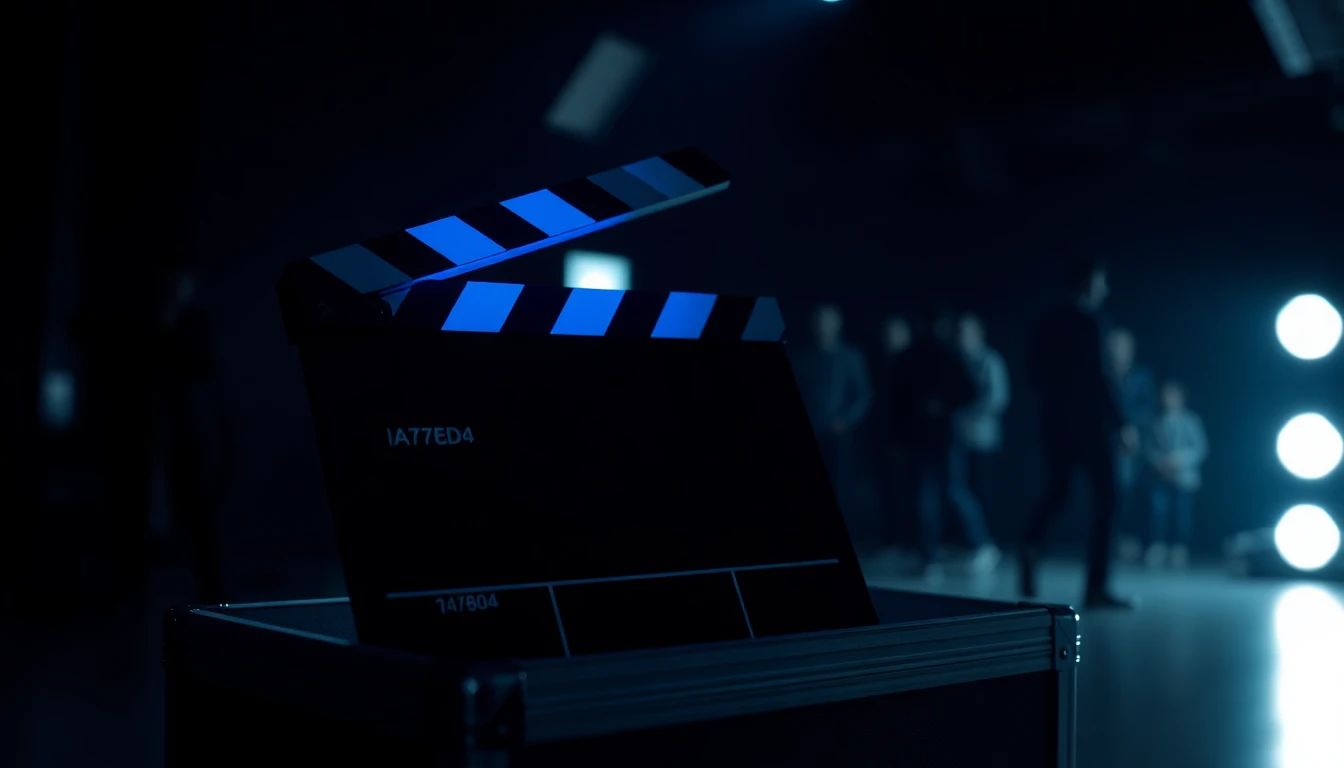
A marketing head walks onto a corporate shoot and watches the camera operator hold a black-and-white striped board in front of the lens, call out a shot number, and snap it shut with a sharp clap. The camera and the microphone are both feeding a digital recorder. The whole stack is networked. The board looks like something from a 1960s film set, and the modern equipment around it makes the slate look ceremonial rather than functional.
The clapperboard, or video slate, did not get retired when film cameras went away. It works harder now than it did in the celluloid era. For any production company running a multi-camera or multi-microphone shoot, the slate is doing four jobs the cameras alone cannot do. A brief from a buyer rarely mentions this, but the cost of a missed slate on a long shoot day is measured in editor hours, sometimes in re-shoots. Here is what the slate is actually doing on set.
What information lives on a slate
At the simplest level, the slate carries written information about the shot being filmed. The standard items are the production title, the date, the director, the camera operator, the shot number, the take number, and which camera is recording it on a multi-camera shoot. Sometimes the lens, the frame rate, the colour temperature, and any specific notes for that take.
For a corporate film commissioned by an MNC marketing team, that metadata is what the editor will use to find every take of every scene in post. A typical brand film shoot produces between 200 and 800 takes across two or three shoot days. The slate is the index. Without it, the editor is opening clips by file timestamp and watching them blind to figure out what they are looking at.
How the sync still works because of the clap
Modern digital cameras record picture and audio on separate paths, even when both are coming from the same source. The camera body records picture. A dedicated audio recorder captures the microphone signal at higher bit depth and sample rate than the camera could on its own. These two recordings are stored as separate files. Somewhere in post, they have to be aligned to the same timeline so the audio matches the picture.
The slate clap is the sync point. The closing of the board is loud enough that the audio recorder captures a sharp transient. The picture captures the visual moment of the board closing. In the edit, the assistant editor aligns the visible clap to the audible clap, and from that point forward the picture and the audio are locked together for that take. The clap is the anchor.
For a corporate shoot using two cameras and a boom microphone plus two lavaliers, every take needs the slate at the start so the editor can sync all five sources. Without the clap, the editor is matching waveforms manually, which is slower and less accurate.
Why timecode does not replace the slate
Modern cameras and audio recorders can both broadcast timecode over a wireless link. The two devices stay in sync continuously. On paper, the slate looks redundant when timecode is already being shared between every recording device. In practice, timecode helps but does not finish the job.
Timecode tells the editor that the camera and the audio recorder were running on the same clock. It does not tell the editor which take this was, what camera angle it represents on a multi-camera shoot, what scene it belongs to, or whether the director called for a re-shoot of an earlier take.
The slate carries the metadata that timecode does not. The clap on the slate also serves as a backup sync point in case the timecode drifts during a long day. Audio recorders and camera bodies sometimes go out of sync by a frame or two over hours of recording. The clap lets the editor re-anchor at the start of each take.
Slate naming conventions on a properly run set
A clean shoot day has a consistent slate format. The first call is the scene number. The second is the shot within that scene. The third is the take number. A typical call sounds like Scene three, shot two, take five.
For a multi-camera shoot, the slate also indicates which camera is recording. A camera and B camera are the standard names. A four-camera shoot uses A, B, C, D. The script supervisor, if there is one, marks each take in the script with the camera letter and the take number so the editor can find every coverage option for any moment.
A naming convention that breaks down on set produces an edit that takes twice as long. Footage logged as scene unknown, take whatever forces the editor to manually identify every clip. Production companies that run their slates loosely often have editors quietly subsidising their crews by burning hours in post reconstructing the shoot day. The slate discipline is part of what a buyer is paying for, even though the buyer never sees the slate in the finished film.
What digital slates add
A digital slate is an electronic version of the same tool. It looks like a tablet with the standard slate information rendered in software. The advantage is that the timecode displayed on the slate is the live timecode being broadcast from the audio recorder. The picture captures the timecode visually, which gives the editor a second independent confirmation of the recording time.
Some digital slates connect to a production database and automatically advance the take number. They also populate the scene metadata in software so the editor inherits a clean log file at the end of each day. For a long-form production with hundreds of takes per day, that automation removes a class of human error from the slate process.
Most corporate shoots do not need a digital slate. A traditional clapperboard with a marker pen is sufficient. The decision is one of scale. For a single-day brand film with 60 to 120 takes, the analogue slate is faster and cheaper. For a multi-week production, the digital slate pays for itself in fewer logging errors.
When a missed slate costs the edit time
The hidden cost of slate discipline is in the post chain. Every take that arrives in the edit with a clean slate at the start gets synced and logged in seconds. Every take that arrives without a slate gets synced by hand, which adds time per take and increases the risk that the editor pairs the wrong audio with the wrong picture.
On a 200-take corporate shoot, a slate discipline issue that affects ten takes adds an hour or two of editor time across the project. On an 800-take long-form shoot, the same issue scales into days. The buyer never sees this directly. It surfaces as the production company quoting a higher post budget or running over schedule.
For a marketing or comms head commissioning a film, the slate practices of the crew are a quiet quality signal. A production company that slates every take cleanly is also a production company that runs a tight post pipeline. The two correlate strongly.
The clapperboard does not look modern. The job it does is more important now than when film cameras were the only option, because modern productions split audio and picture across more devices than ever and the editor still needs a way to align all of them. The board is the anchor for that alignment. Every clean slate at the start of a take saves time at the back of the project.
Dustin Hill Productions runs the standard slate discipline on every shoot, from a single-day corporate film to a multi-week long-form production. For corporate video production where the buyer is judging the final cut and not the production paperwork, the slate is one of the small disciplines the audience never sees but the editor always feels.